
Minimum Viable Shangri-La After All
It's the Atmosphere, Stupid

[Audio version here on Spotify!]
A note to the few of you I’ve talked to on what today’s post would be about. It wasn’t supposed to be this one. It was supposed to include a new poem. That’s still on its way—maybe for the Sum Day that occurs midweek, on 4 + 22 = 26. I’d started this one two weeks ago, and even though tomorrow’s “4/20” has nothing to do with my using the song below, nor it being the 27th year since the Columbine shootings, I guess the connection can’t be helped. So here we go.
The famous supposed quote, “It’s the economy, stupid,” apparently began during Bill Clinton’s presidential campaign in 1992. It’s coolest to not have been born by then, which is kinda crazy when it comes to the need for experience and intellect in evaluating ideas—but the sentiment is convenient for our Foes of Flourishing trying to get us all to hate this place and board big flying saucers to leave in, off the top of skyscrapers, as this story goes. I can’t digress. (But you can hear the saucers starting up and taking off in Radiohead’s song “Blowout” starting at the 2:45 mark, according to Stu.)
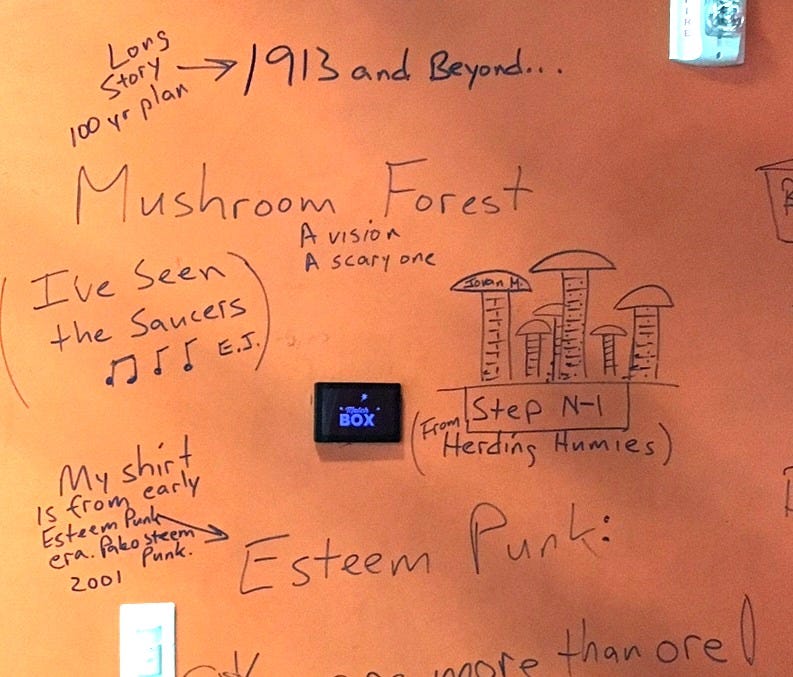
Shangri-La is a fictional name for a potentially useful fiction about finding paradise, basically. I’ve never been interested in a paradise, and I don’t know what percentage of people are, but I don’t think it’s very high. So I wasn’t talking about paradise twenty years ago when I started wasting some science class time by telling my students about what New and Improved Role many tiny rural towns could play, in life and economics, and in an authentic way. Disney need not apply, you could say. Paradise can wait for some way off distant day.
Thinking seriously of a paradise as a state of things isn’t usually very useful, it might even be counterproductive in setting hopes much too high. But thinking about probable components and how they might work together differently might actually be useful. We certainly can’t expect Adam Smith’s Invisible (and apparently pretty much blind) Hand to manage things very well. The fairly ridiculous proposal that it would work out well (not that he actually proposed it as a developed principle) is a tool of the Foes of Flourishing that want us to leave (as mentioned in the caption above).
But that does not also mean Adam Smith’s (and others’) legacy of “capitalism” itself and in general is also a tool, just that it can be fashioned into one, like so many things. There’s hardly anything the Foes (the Stralfs) can’t fashion into a tool once it’s separated from an integrated whole, even ideas about love/affection.
At this point, it’s a risk we take, with everything, and neither democracy nor communism nor despotism nor marching in the streets can take the risk away. And the Foes, the Stralfs, represent this aspect of our human condition, which is our vulnerability to hacking and dis-integration, painfully, critically, exploited with new tactics in the last hundred years or so.
And what will they be there to offer in that pain point/solution sequence marketers depend on, after having caused, concocted, or exacerbated the pain? Their (truth be told, crappy) planet. Their proposition mostly provides a sense of starting over and doing it right this time, although also the pictures are truly appealing, like Earth can be.
The instrument of pain point/solution peddling is huge in all this and in everything, especially in the last hundred years of increased emotional sophistication on the part of marketers/peddlers—even in cases where all they seem to be selling is an idea or attitude, and at no upfront cost.
We humans aren’t great at sophisticated cost/risk/benefit over time, so mistakes or injuries get made, infection often sets in, our cognitive dissonance-averse brains take a shortcut. Or maybe we’ll take a picture of a plaque that justifies the mess we’ve made, and in resignation call it art, because there is no going back.
The Stralfs depend on this as they coo their songs to us in the silence—or at the concert. They’re full-spectrum influencers, loving how time, being a typical one-way river, and emotional accumulations, are on their side. Starting over will look good to the victims, and only possible on planet Stralf, the Stralfs imagine.
The humans are generally a caring bunch, Bug Stu has observed, which means they generally want to be seen that way, and that is extremely complicated. Throw some toxic and corrosive pop slogans into the mix, vaguely attach them to some vague philosophy or spiritual imaginings, and you have both personal and collective disintegration, leaving escape or “shooting your way out” as options. There is no forgiveness nor reason to say you need it, in so many cases, but that doesn’t take into account the inherent and often conflicted caring nature of humans, misanthropic slogans be damned.
But Then Along Comes Mary
The trouble with looking for meanings in songs or anything else is that there’s always more than one, and every one of those has both roots and branches. Summation and essence are almost always misleading in their supposed simplicity. It’s okay to start there though, like with “Along Comes Mary,” the very catchy and complex song from 1966 by The Association that passes as an early kind of veiled cannabis advocacy, as it’s mostly known. That’s not why I titled this section with it though. A different association…
I had just been thinking of following the earlier paragraph with “But then…” when that song title popped into my head (actually, “and then along comes Mary,” is the lyric, not “but”). That was convenient because I’ve been noticing something in real life related to this whole Shangri-La thing.
Real life is what you might call the third (outer) layer of The Story of Stu. The first layer is the story that Rhettie and Wally have been working on, which includes a sort of musical series, one that they’ve called A Counterfactual Quasi-Fictional Meta-Musical Mockumentary: What If We Hadn’t Been Invaded By Aliens 200 Years Ago.
The second layer is the story of Rhettie and Wally and their…associations—the word of the day here I guess. Some of our associations change dramatically, but not all.
Some we seem to be married to, a metaphor which would have made more sense in 1966, come to think of it. Neither Rhettie or Wally are married, and Rhettie is very careful about making an association toooo meaningful, if you know what I mean. (Yes, there have been attitudinal hacks for this nuisance meaningfulness, especially the last fifty years, if you know what I mean. An open-minded jury on these practices has been impossible to select, so far, but maybe AI could be summoned...)
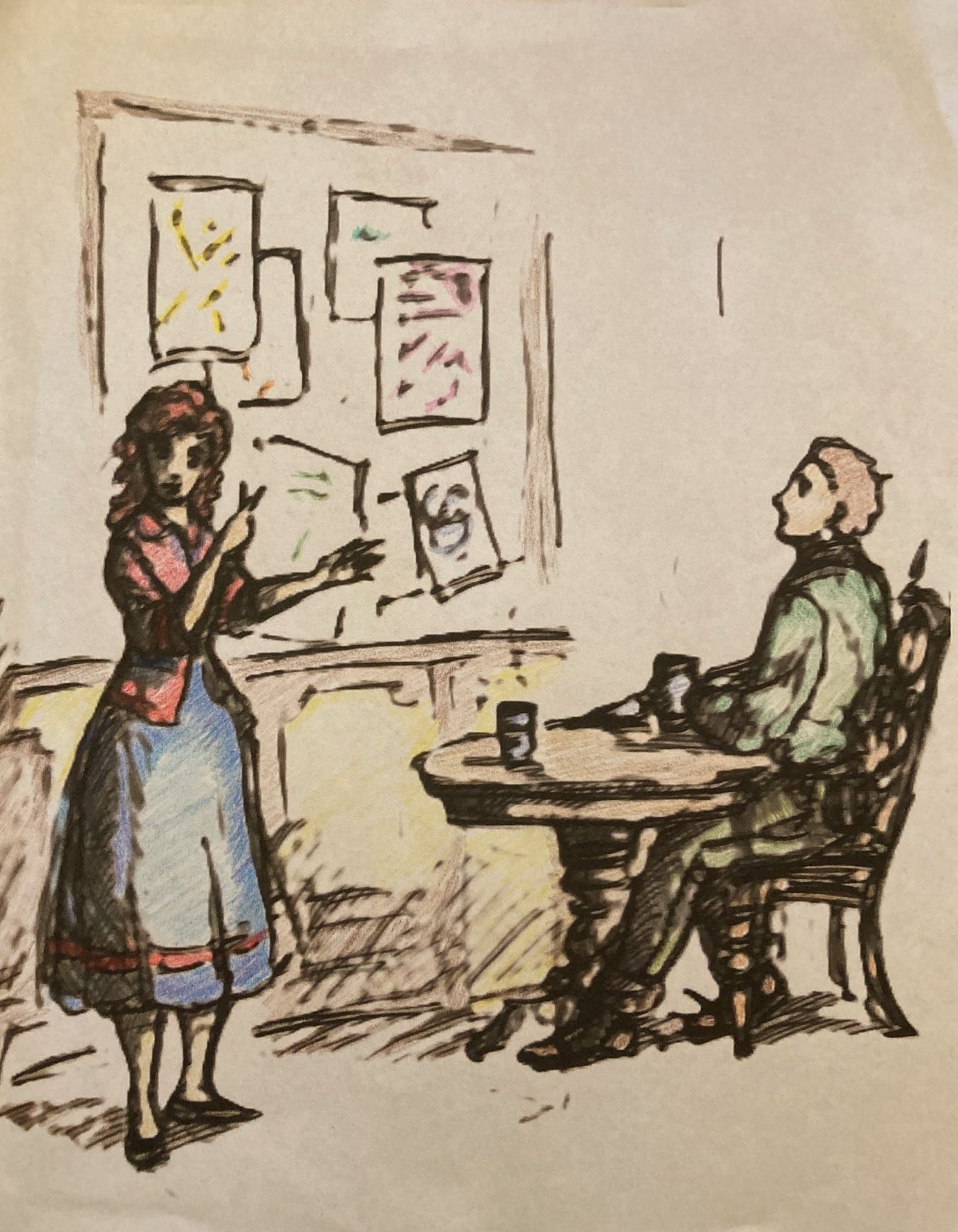
There seems to have been a convergence brewing with Rhettie’s other associations, not that any of them would want to be called mere associations. Older brother Brit (I’ve been using two t’s lately, but then I realized that was wrong upon checking the unpublished book) and her informally betrothed Nathan have reconnected and just as they’re also both talking about coming back to Ade Country. Grandma Dorie turns eighty-six this year and hopes to see Rhettie’s vision start to become real, before she can’t see it, as she says euphemistically.
In the third layer, lately, I’ve been observing something I never expected to see, and with multiple meanings, of course. Speaking of this, observations and meanings, we either need to be very cautious or very tentative with these interpretations, open to reassessment and re-imagining, maybe especially when we’re trying to figure out other people.
This is fresh in my mind due to a very recent conversation, in which I was the one being figured out, theoretically, not that I don’t work on that myself with some frustration. Sure, it’s intended to be a problem-solving exercise, usually, but because of the lack of information or the selective gathering/memories on the problem-solver’s part, even me, it can be counterproductive, even somewhat confusing in terms of motivations—conscious, subconscious, situational, and all that, with mutual ambiguity there.
Coincidentally, I had talked about a related orienting issue at the Teays River meetup a few weeks ago. A week later, coincidentally, I read a 1994 book on the idea of “the religion of psychology” (which was a little too polemical, but only a little). In both the Teays River conversation and from the book, it seems like there’s a faith placed in a half-dozen magic bullets, to kinda narrow up the distribution of folks according to the latest popularized idea of ideals and allowable variation.
I had told my associate at Teays that I’d sensed this narrowing up happening in the 90s, through one particular talk show. However, the book I’d read was in its second edition in 1994, with the first edition having been published in the 70s. It just hadn’t clicked for me. Fascinating, how we’re formed and then form others.
Back to the Mary Thing
Remember Easter? Remember Women’s History Month? Remember the paragraph about profoundly complex and profoundly caring humans back up just before the subtitle “But Then Along Comes Mary”? And remember last time how there’s a stronger and riskier religious element in our four characters as one of them mentions “As for me and my house, we will serve the 7th Pie?”
You can find a few different definitions of the word religion. I, nor Stu, can help thinking of “the people of a shared story” as the most appropriate one, one that includes people who say they are not religious, in their rather narrow and unreflective consideration of the phenomenon of human orientation here in Reality.
One of the Mary’s who came along in the story they’re at least becoming part of is Jesus’ mother Mary, of course, and the other is Mary Magdalene, of course, who had a past that she didn’t want to be part of anymore, if she ever did. All clinical attributions aside, she took part in something for quite a while that she came to regret and even resent. She could have embraced it instead, but she didn’t. Who knows for sure why not.
Our culture would say embrace it, if you want to, or blame someone else, as there are plenty of equally imperfect humans under the influence of exceptions to the caring humans generalization. Or maybe the influence isn’t human, maybe it’s Adam Smith’s free-ranging Invisible Hand, or little aliens with a plan.
Maybe write a bunch of angry music about it all, maybe a whole album unintentionally about how a few generations were never told what real life on Earth can become when certain naive stories are adopted with the certainty and power of religions but claim to be free of or above religion. It’s hard not to think about our 30th year here in the Land of Kent without thinking of Alanis Morissette, The Cranberries, No Doubt, and what Stu calls the Man Bands like Pearl Jam, The Verve Pipe, Counting Crows, etc. (not that they all weren’t worthy of more than etc.).
But A.M.’s Jagged Little Pill was the boldest and the least self-aware, not that it wouldn’t or doesn’t still resonate. It’s hard to be self-aware when your religion was unwittingly adopted, infused might be a better word, and said to be against religion even while it had all the unavoidable markers of one, the good ones and the bad ones.
I can’t help but go to one of the least known of those songs, “Forgiven”, be in love with it only partly for its ambiguities, and also want to ask “one more…stupid question” (she says that so well). It would be about what evidence there’s been that the so-called emancipatory religion of the 60s’/70s’ has delivered more than a jagged little pill in the way of the serious subjects of peace, harmony, and happiness?
The atmosphere, which is largely what it’s all about, that the era created is finally starting to clear out, and you can see it on a good day. I see more and more of these Gen Z kids who seem to have asked the same stupid question I’ve been wondering about for thirty years, the children of the Children of Grunge/Post Grunge, which was the ignored cry for help almost thirty years after the Counterculture, according to Stu.
The title today was Minimum Viable Shangri-La After All because even though it is not perfection or paradise that we should be looking for, and certainly not expecting, I have seen the difference that the intellectually honest and hopeful orientation makes in these Gen Z kids, at church—of all places. Right? It makes a more solid kind of sense to me now, and to them apparently, compared to the “kids” before them. Maybe they understand religion better than others.
I have no Cursory Rhyme for Our Curious Time today, but maybe on the Sum Day coming this week. We’ll see. It’s already mostly written, and Brit is the one who has written the poem : ).
Thanks for reading.
Tim