
From Instagram Bubble to Brightspots
With Much Trouble

[Audio version here with the others on Spotify]
The concept of social media bubbles is usually used in a negative way, the echo chamber of grievances, dereliction, and deceitfulness, not to mention doom. On the other hand, Instagram (I’ve stayed away from Tik Tok after realizing in five minutes that it would have too much pull for my resistance) became a sort of customizable magazine of things we like, like the old perspective-resetting Midwest Living magazine but with moving pictures and comments and immediate access to more information.
And that is kinda like the bubble that Rhettie’s older brother Brit created there, because it was the best way to keep his mind focused, happy, and learning about other tradesmen and popularization of his realm of architectural restoration, among other things.
Brit is 45 now. Incidentally, Midwest Living was still well-known back when he was in high school at Lane Tech in Chicago—Class of ‘99. Brit would run across copies in waiting rooms here and there, and it would remind him of Grandma Dorie down in Ade Country. His appreciation of its depiction of rural life is probably one reason Rhettie, ten years younger, was influenced to live with Dorie in the summers and how this whole story got rolling.
Funny, I just realized that I was Brit’s age when I noticed that tiny rural towns had so much more to contribute to human flourishing than even romanticized Hallmark-card-coated imaginations contained, and that the economics were practical not just fanciful wishful thinking of uninformed nostalgia.
Over the next ten years the complications and realities of relatively recent philosophical legacies changed part of my focus, and I guess I decided I could only see things properly through the compound eyes of Bug Stu, another music lover. But that meant I would be drawn into his whole story, including the effort to make him real in order to keep something darker from becoming real. Much of that was in the last issue.
But Back to Brit
This certified 90’s kid, Brit, has re-emerged in this story behind The Story of Stu here, not that everything in the 90s is worth certification. No decade can claim that. Some are just worse than others for human flourishing—which is kind of what it’s all about, human flourishing, realistically speaking, speaking in that lower case d dao-ic way Brit’s and Rhettie’s grandma Dorie does. It’s not a simple concept, nor does it seem to involve only the human, not that we often grasp what those four italicized words mean, according to Stu. (So many characters, in real life and otherwise, as Guitar Steve said the other day. It’s nice that we only have to keep the otherwise ones straight here.)
Dorie is generally very careful with her words, so she says “lower case d dao-ic” to avoid the founding “Daoists’” implication that they alone had chosen the true Dao for themselves, a tactic meant to oppose Confucianism, as if Confucianists and others didn’t also believe in the true Dao or dao. A clever move, and not unfamiliar to us Westerners, but also transparent, maybe deceptive, or maybe dubious in its effectiveness, as it was to Dorie.
Awareness though, of these games, and other games, and not obsession, is what Dorie has tried to pass on to Brit and his younger sister Rhettie. So they both try to focus on the positive arcs and chords within the spheres that make up reality. Choose your discordance wisely, Dorie would tell them, with the usual two or three meanings.
Related, the realization that human flourishing requires more than earthly pleasure and/or avoidance of pain just goes with the territory she would say, meaning the territory of being human, a territory which is also beneath, within, and above them, and never to be separated really.
Awareness Before Doing “The Work”
A lot of personal improvement leaders talk about doing “the work,” but “the work” is always a form of cultivation, which always involves a previous often unrecognized decision about an outcome, and the side effects, and a reason to truly trust, all before doing “the work,” similar to cultivating a patch of land. All that takes us to the three semi-celebrated days of the past week, which will be integrated in today’s post.
Monday was 4/20, the day we remember our marijuana but still don’t forget Columbine HS, from 1999. Serious stuff even in a passe dystopian aesthetic that’s given way to a trauma aesthetic. The 90s gave us the ignored cry-for-help from the beginning with Grunge, according to Stu as I’ve mentioned recently—and it’s Punk’s younger brother, or younger sister in the case of Alanis Morissette, ubiquitous then since 1995. Much more on two lesser known songs from her Jagged Little Pill in a second. Thank you, Brit.
I realize that Gen Z typically only knows these iconic lyrical essays through their parents if at all. But it’s good to know what’s formed what’s formed you—a regression analysis that should be made more often by sincere, genuine, responsible stewards, according to Stu.
Alanis’ song “Mary Jane” is clearly and doubly appropriate for the day here, and tearfully taken in if you understand the connection between this song and “Forgiven” in real life human Alanis, on an otherwise exploitative album employing an exploitation aesthetic. How did we/she get there, is the unmentionable one more stupid question.
Wednesday was 4/22, Earth Day, a fractionally serious and maybe negatively impactful token expression of stewardship, at least for most of its over-glorified life. 4/22 was also a Sum Day, as 4 + 22 = 26. Sum Days are for (responsible) bold words and bold actions. Most of this post was written on that day, and responsibly.
It would be irresponsible of me to ask you to take time to listen to both of those songs, unless you are somewhat familiar, maybe having already known of them once but maybe passing them by. They are the most beautiful and powerful songs on the album, and had they received the attention and saturation given to the others, the public could not have stayed on its questionable course, according to Stu. He knows this stuff pretty well.
Deeper questions would have been considered, awakening an awareness that The Machine wasn’t ready for, let alone the Stralfs. When interpreting the songs, you have to realize that Alanis can be…a little too ironic, in that other sense. That should be pretty easy to remember. And that leaves room for twists in meanings that the good-girl-gone-bad trope overlooks, like we overlook so many things.
To The End
Rhettie was always an absorber and Brit was always a doer, not that they didn’t overlap a lot, especially as they’d gotten older. As I think about this, it strikes me that Rhettie was sort of able to synthesize from absorbed ideas then happened to have connections with three people who could make the resulting vision become real. I mean, it’s not like she had really chosen them from among others. Her visions were fortunate, you could say.
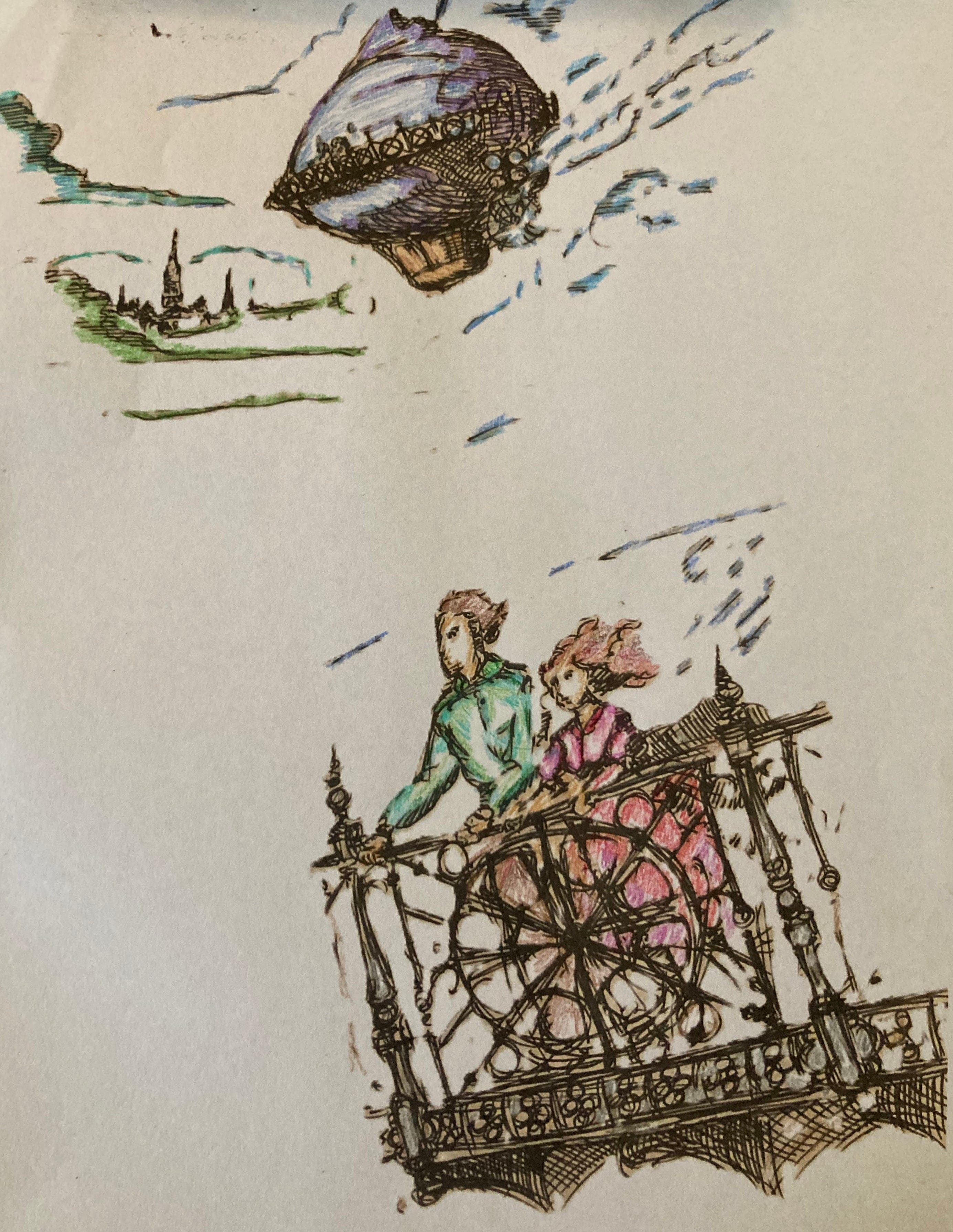
As in the last couple of issues, Brit’s (somewhat differently constructed) poem touches on the broader meaning of the term religion and the halting implications. There’s a repetition of Alanis’ lines in “Forgiven,” among other things, that make me wonder if he was a little bit in love with her, as so many were in that era. Really though, mainly, this is about Brightspots, as with the last few issues, and including some elements you might not be familiar with, and he shared it with Rhettie, just recently.
Clinging to A Different Scheme
Take me to a Landing
out where I can see the stars,
where the day is so much different
from the office and from the screen.
Clean.
What that might mean.
Take me to a Brightspot.
Fading memories, fading scars,
where the question’s not the cost for rent
but do I love the scene.
And where’d this dream get taken
from me?
Shaken and misshapen
of me,
one to care for flocks and flowers
—and fish, and contemplate for hours,
or care and put my tools to use
on buildings under Earth’s abuse.
For decades no aid visualized,
just squandering the countryside,
plundering the stories formed
since creeks and swamps and woods were stormed.
Debate and blame,
inflamed derision,
friction, fissures,
or instead a vision.
I’m downtown. Half a mile from here
are willows, winds, and ponds
and with innovative waterways
for seining, herding, prawns.
Rhubarb hides the guards, the toads.
Carts not cars and paths not roads.
Lavender along the lane,
and fires at night.
The heretically sane.
The pawpaw patch.
Fruit overlooked.
The theme and thesis here.
Persimmons gathered,
puddings cooked.
A sweet and blessed beer.
Roofs of thatch,
no match for tiles
that someday might
be seen for miles, but we,
in our IndSteadavision,
can’t wait for Perfect’s slow provision.
Kintsugi, the imperfect way
in entropy, the come-what-may,
or come-what-has, as the Christians say,
but the glue’s the same, and same’s the clay.
Another day, another dot
connected to the rest.
The Piece Core Crew held rot at bay,
and more than I’d have guessed.
What’s rot but decomposing,
parasitic ways and means,
and with dead things it has purpose,
but not whole and helpful things.
I walk into the shop to find
a boat with oars for three.
It’s about a choice,
three by design—for Rhettie, someone, me.
And someone else will use the boat,
just two, this second vision,
but there are always three
in what my grandma calls
One great decision.
It’s late.
The Star Eyes tuck me in.
The Dobro cried; the mandolin
said every human has a soul,
said every human needs made whole.
But how, with no ontology,
no fifth realm, flat biology,
and misanthropic emancipators,
alien illusional adjudicators.
We listened, learned,
then baked them, acted,
our tracks I mean…
never changed I mean,
and filmed the scene,
couldn’t be retracted.
So then “We all needed something to…
cling to, so we did.”
I’d never heard the song that way,
the meaning that she hid.
Grandma saw the door,
or window.
She’d watched it all before,
and she’d know,
how the peddlers changed the garden,
how her own kids then
would wince and harden.
And they…they all needed something to
cling to, and they did
—or face that they’d been wrong.
They’d clung to gods of Me and Now,
stone idols all along.
I see a snowman made of stone,
crude eyes of reddish chalk,
crude lips and nose, a path to him
where weary pilgrims walk.
They find him dull and oversized,
unwise. They find his wife,
once mesmerized by power
and all the wants he’d brought to life.
Now she seems to look away,
“Where was my mind?” she seems to say.
Where is my mind? I’d asked today,
and what does inattention pay?
And what does inattention cost?
Like missing that the chalk wears off,
that rain would wash his face.
So someone, something, maintains
this late idol of the human race.
Something knew…we’d cling to
what we’d sing to, and we did.
We watched new plays play on TV,
each grownup and adoring kid.
We all had a thing to learn, or two,
and sing along.
And bring along a friend, or ten,
if our appeal was strong.
Stone gods…
Now there’s your consecration…
groomed, festooned, by an alien nation,
well aware that we’d need more,
and that’s what they’ve done all this for.
Confounded by the thought “Forgiven.”
Stone gods don’t forgive.
Compounded by an inattentive
sacrifice to live,
they send us to the saucers
bound for somewhere’s distant shore
in the fight for something peaceful
with less costly quests for More.
But wait, just take this boat and oars.
I’ll go and row with you.
These stars, these shores, they’re yours,
don’t let them take them from you too.
I’ve seen the grotesque gods they cling to.
I’ve heard the straw men fight, argue.
I found the plans to vacate Earth.
I doubted claims of Second Birth.
But, you tell me, what are the odds
that they’ll bring peace,
those cold stone gods.
I for one want more to cling to.
You say you have no god. You seem to.
Choose this day which story wins,
who’s in the boat, how rowing ends.
I want to feel the Stars, their smiles.
If you might, I will row for miles.
Brit K.
Thanks for reading : ).
Tim